here I am inspired to introduce Petinder (which is developing to a huge AdoptPetHub.com brand).
Starting in 2022 as a Social business startup Petinder involved both business and social parts, building strong core team, amended with a wide number of volunteers.
Social part of the service offers search engine for pets adoptio0n and care, including leisure options, co-workings, sport events, hotels, beaches, and many other services.
The business part includes “tools and information on dog walkers, pet sitters, dog trainers, and groomers, helping pet owners find trusted professionals to care for their furry friends”.
The inspiring essence of this project is hybrid – employees and volunteers team.
AdoptPetHub.com
The service is rapidly developing leading by its Founders, and now it’s transforming to a larger Adopt Pet Hub mega service!
DASA – the leading DASA organizational culture provider – shared a set of antipatterns, based on myths, which strongly oppose DevOps adoption and adaption. In my practice I often meet “devops engineers” and “we implemented devops, because we have ci/cd”. Let’s understand, what’s difference, and why DevOps culture first and precedes any technical tools, and why tools cannot create devops (rather they can be helpful locally).
DevOps Antipatterns: However, in practice, DevOps has different meanings for different people. Due to this confusion, organizations don’t realize the benefits of DevOps. Here are some antipatterns.
Agile is for development teams, and DevOps is for the downstream teams: Wrong. DevOps is about building end-to-end product teams, who own the product and are responsible for it throughout its lifecycle. These are the teams Amazon and Spotify popularized: the two pizza teams with build-and-run responsibilities.
DevOps is a CI/CD pipeline: Another common antipattern is to confuse a CI/CD pipeline with DevOps. DevOps is more than implementing a CI/CD pipeline. It is about embracing the technical and cultural practices that enable the smooth flow of small batches of work from development to operations, getting continuous feedback across the delivery pipeline, including from operations, and continually improving the process and the product based on feedback.
The mythical DevOps engineers: This antipattern is widely prevalent and perhaps the most stressful for the unlucky person. Instead of the entire organization owning the improvement of software delivery performance, a person is responsible for it. Predictably, this doesn’t work. Instead of DevOps breaking silos, organizations create another silo and a bottleneck – the stressed-out DevOps engineer.”
I -, Dash, T- competency profiles became very popular for the last 5-7 years due to their value in Agile teams forming, and also building career tracks for professionals in the VUCA world.
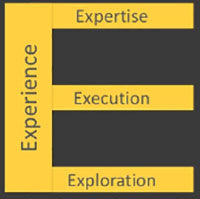
Below is an excerpt of this article about newly designed M-, E-, ans X- shaped competency profiles.
“M-shaped people have evolved from being Pi-shaped into those who possess multiple specialties (the vertical part of the M). From a resource management perspective, a person with one or more specialties are more adaptable than someone with a single speciality (I-shaped person) or even Pi-shaped. As such, each additional speciality changes the letter “M” to a comb. That is, where a person possesses more than three specialties to resemble a comb shape.
E-shaped is a new paradigm shift, where people actively demonstrate a combination of four characteristics – Experience, Expertise, Exploration and Execution to form the letter E. E-shaped people who demonstrate the breadth and depth of knowledge have expanded their knowledge to include tangible (execution i.e. proven ability to deliver) and intangible (exploration i.e. proven ability towards continuous improvement) specialities. This implies the person has both vision and granular detail to make a discernible difference to the organization reminiscent of being a best practice practitioner in whatever domain or competency.
X-shaped people have a higher degree of self-awareness, adaptive capacity and the competencies to thrive in the future. Similar to the self-actualisation in Maslow’s Hierarchy of Needs, this employee type refers to the pinnacle of individual capability and competency. That is, X-shaped people demonstrate uniquely human skills that are grounded in empathy and purpose. They move from domains of knowledge to a constant state of learning, continually adapting to the environment. People with X-shaped skills have deep expertise in specialities (or knowledge area) as well as strong leadership skills and credibility.”
Involving volunteers is a winning strategy for a startup. But a big question arises – what are specific management and motivation activities for volunteers’.
First, the basic recommendation is that you manage volunteers as employees. If a volunteer takes responsibility for a project (its part) she or he is responsible
Second, motivate with giving transparent perspective of the project and potential volunteer’s involvement. It helps a volunteer to align his/her plans with your project. And for startup founders it provides more predictability – if a volunteer goes to leave a project he/she can notify in advance.
Third, agree on schedule in advance, at least a month ahead. For example, a volunteer is ready to be involved 10 hours per week.
Calling all entrepreneurial minds! Only 3 days left till this year’s biggest G-Accelerator event: DEMO DAY 2021!
Join us online, live, on Wednesday April 14th, to see which 2 of our residential projects will deliver the best pitch and win the investment funding from Spain’s biggest market leaders!



 IT startup mentoring framework