
Category: Digital
Unlocking AI: Practical Applications for Business
AXELOS/Peoplecert – the famous ITIL(r) provider issued the AI Unlocked online course. It deals with practical AI implementation for business, including risks, challenges and potential ethical issues.
Here is my badge, join my courses and services!

DevOps Engineering Skills

DevOps is an organizational culture and approach, which is tightly based on technology.
AXELOS(r) presented the set of DevOps engineering skills for now and nearest future for DevOps team members –
Microservices
Nanoservices
Open source
Blockchain
RPA
NoCode
AI/ML/GPT
IoT
CLoud computing
DevOpsSaaS
DevSecOps
DBOps
5G Access
Observability
Federated Value Streams
Work from Home
AI Tools Integration in Project Management Activities: Market Insights
The Project Management Institute (PMI) has released its own study on the penetration of generative AI systems (GenAI) into the field of project management.
The general conclusion is that at the moment GenAI is mainly used to solve general administrative tasks – control of planning, execution, reminders. This is due to the lack of deep integration of generative AI systems with project management tools.
The greatest demand has been identified for obtaining knowledge and recommendations from AI systems to improve the efficiency of work flows.
AI penetration rates vary significantly from 4% of organizations whose technical proficiency is assessed as “catch-up” to 38% for technically advanced organizations.
28% of organizations do not use AI at all, 45% at a minimal or medium level, 14; — significantly integrated AI systems into their project activities.
Most often, the use of AI tools in project management begins with the analysis and summarization of informal texts – interviews, minutes of meetings, etc. The highest percentage of involvement is for companies on the Microsoft Dynamics platforms (48% on average in the market and 90% in the segment of large corporations) and Azure services (95%)
The majority of respondents rated 4 factors as the most important for the successful implementation of AI systems – data, infrastructure, staff talent and corporate culture.
DevOps Culture Myths and Antipatterns
DASA – the leading DASA organizational culture provider – shared a set of antipatterns, based on myths, which strongly oppose DevOps adoption and adaption. In my practice I often meet “devops engineers” and “we implemented devops, because we have ci/cd”. Let’s understand, what’s difference, and why DevOps culture first and precedes any technical tools, and why tools cannot create devops (rather they can be helpful locally).
DevOps Antipatterns: However, in practice, DevOps has different meanings for different people. Due to this confusion, organizations don’t realize the benefits of DevOps. Here are some antipatterns.
Agile is for development teams, and DevOps is for the downstream teams: Wrong. DevOps is about building end-to-end product teams, who own the product and are responsible for it throughout its lifecycle. These are the teams Amazon and Spotify popularized: the two pizza teams with build-and-run responsibilities.
The DASA DevOps team competency model illustrates the skills and knowledge areas of an end-to-end responsible DevOps team.
DevOps is a CI/CD pipeline: Another common antipattern is to confuse a CI/CD pipeline with DevOps. DevOps is more than implementing a CI/CD pipeline. It is about embracing the technical and cultural practices that enable the smooth flow of small batches of work from development to operations, getting continuous feedback across the delivery pipeline, including from operations, and continually improving the process and the product based on feedback.
The mythical DevOps engineers: This antipattern is widely prevalent and perhaps the most stressful for the unlucky person. Instead of the entire organization owning the improvement of software delivery performance, a person is responsible for it. Predictably, this doesn’t work. Instead of DevOps breaking silos, organizations create another silo and a bottleneck – the stressed-out DevOps engineer.”
Product Roadmap presentation by YouGov
YouGov shared the wonderful template for presenting your product roadmap in the inspiring and attractive way.
Use the suggested graphics and even – animation video! – and present your product to investors, customers and other decision-makers in the best imaginable way!
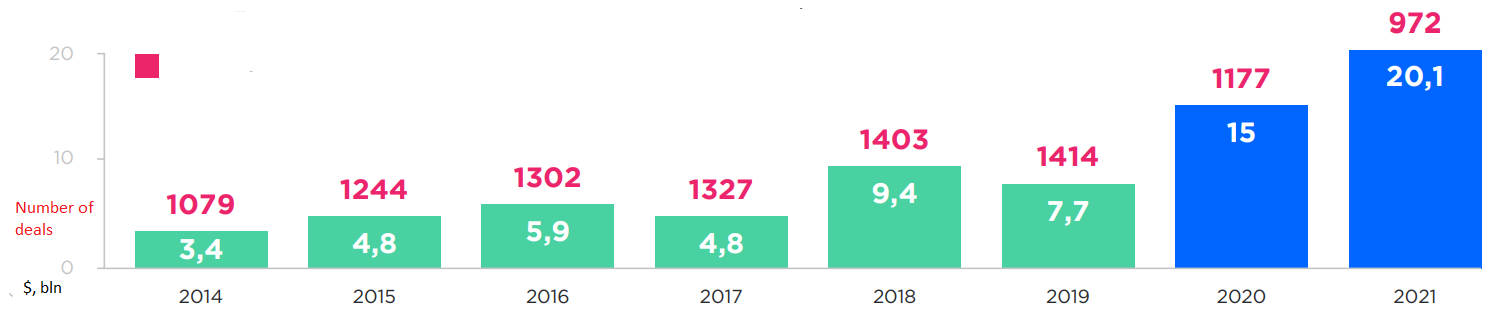
EdTech is a new startup niche
Investments in EdTech startups grow dramatically during COVID and are continuing their growth both in number and average volume of an investment.

Digital transformation leadership by ITIL
ITIL, the most famous IT service management framework by AXELOS (former OGC Great Britain) issued the Strategic Leader certification.
A Digital Strategic leader is a passionate leader who possess knowledge, skills and capabilities in transforming operational processes, products and/or services to disrupt industries and markets with new opportunities, operational excellence, and new products.
The Strategic leader track includes strategic, financial, operational, leadership aspects of digital strategy and digital transformation.
 IT startup mentoring framework